Analyzing and negotiating
Three Questions I'd Ask Brandon Turner About His $15M Loss
Easy capital, a sub-4 cap in Houston, and the jump from mobile home parks to multifamily: the three questions behind a $15M multifamily loss.
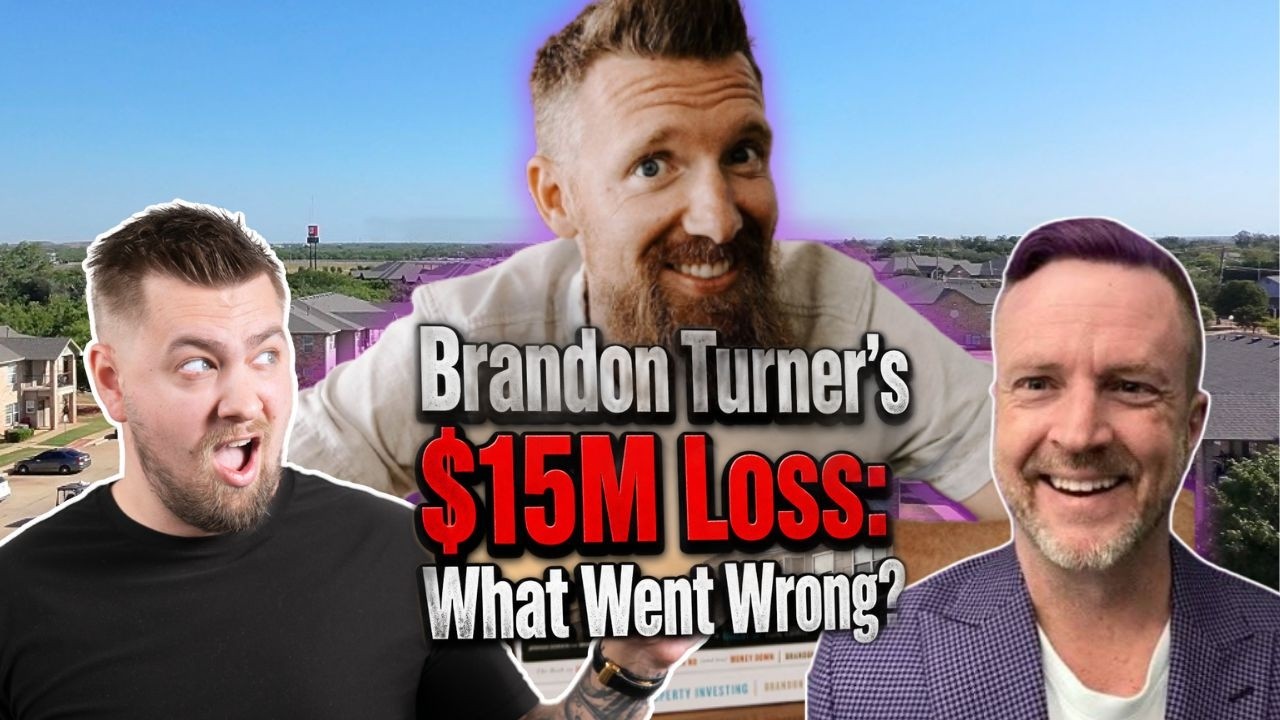
Every so often a deal goes wrong publicly enough that the whole industry gets to learn from it for free. Brandon Turner's $15 million multifamily loss is one of those. In this clip from our longer breakdown, I walked through the three questions I would ask him if he ever sat down across from me, and my guest pointed out, fairly, that those three questions are exactly why he probably never will.
Related reading: Brandon Turner's $15M Loss: What Actually Went Wrong
None of this is a dunk. Brandon had already made it on every metric that matters before this deal existed. That's what makes it worth studying. The questions below aren't about whether he's a good operator. They're about the specific decisions that turn a good operator into a $15 million loss, and every one of them is a decision you and I can make on a much smaller deal next quarter.
Question one: did endless money make you do a bad deal?
This is the one that's closest to the grave, and my guest answered it before I could finish asking.
"If I was Brandon, I would probably answer that question: you know what? Yes, it did. That had to be a factor."
And there's the problem. That's a hard question to answer honestly in public, because the moment you say yes, you've said something that carries liability with it. You can't say yes. But the answer kind of has to be yes, because nobody else could have done that deal.
That's the part worth sitting with. On that deal's fundamentals alone, the pitch doesn't work. You couldn't raise on those numbers without the brand attached to them. My guest put it plainly: he and Michael combined, with all of their capital raise power, could not have raised for that deal. He couldn't convince anyone to massively overpay for a property, and it was a big one: Brandon raised something like $25 million in total.
That's the trap of having access to endless amounts of money. Capital is supposed to be the constraint that keeps you honest. When you're raising your first deal, the numbers have to carry the pitch, because nothing else will. Investors ask hard questions and the deal either survives them or it doesn't. That friction is doing real work on your behalf, even when it feels like it's just slowing you down.
Remove the friction and the filter goes with it. If money shows up because of who you are rather than what the deal pencils, the deal never has to defend itself. The brand raises the money, the money closes the deal, and the fundamentals never get their vote.
I'd rather have to fight for every dollar. Having to convince someone to fund a deal is free due diligence, and it's the cheapest kind you'll ever get.
Question two: did you really think a sub-4 cap in Houston would go lower?
Here's the second one, and it's the other reason he's not coming on my channel: did you really think a sub-4 cap in Houston would compress further on the exit?
A lot of people thought that at the time. That's true and worth saying. But a sub-4 cap in Houston was the historic low. It had never been lower there, ever. So the exit assumption required a market to do something it had never once done in its history.
We tried to be fair to it. There was a lot of operational upside in that deal, and to Brandon's credit, they technically hit their operational upside. He wrote the book on rental properties. Managing the asset and driving NOI is the thing he's genuinely good at, and he did it.
But operations don't save you from that kind of entry price. If cap rates had stayed flat (which they weren't going to) or even ticked up a little, you can make an argument that the NOI they added might have been enough to carry the deal. Brandon might survive that question on those terms.
Nobody survives the cap rate doubling when you overpay. That's the line that ends the debate. When the cap rate doubles, the valuation math swamps every operational win you booked. You can add to NOI all day; you cannot add fast enough to outrun a denominator that moved that far against you.
My follow-up, if he had answered the way my guest did, would have been simple: what's the historical cap rate for Houston? I genuinely didn't know the answer when I asked it. If Houston's historical average is a five, then buying at a sub-4 is aggressive but it's at least in the neighborhood of reality. If the historical average is closer to seven and a half, that deal was dead the day it was signed.
My guest's read: Houston has fluctuated in the 5.5 to 6.5 range, and depending on the submarket, you'd call most of Houston a five-and-a-half to six cap market: probably a six-and-a-half cap market in some areas.
Sit with that. If the market's honest long-run range is five and a half to six and a half, and you bought at a sub-4 assuming the exit goes even lower, you didn't underwrite a deal. You made a bet on a market doing something unprecedented, and you funded that bet with other people's money.
This is why I'm so stubborn about underwriting on today's numbers. Never buy on anticipated rent growth, and never buy on anticipated cap rate compression. Both of them are the same mistake wearing different clothes: you're paying today for a future you don't control.
Question three: was it ego or boredom?
The third question comes from how I understand Brandon's path, and it's the one I actually find most interesting.
He started very much one rental at a time. That's what got him to Hawaii. Then he moved into mobile home parks, and as near as I can tell he had wild success there. Then he went to multifamily.
Houses to duplexes to mobile home parks: that progression makes complete sense to me. I would invest in that. Each step is adjacent to the last one, the skills transfer, and you're compounding competence rather than swapping it out.
So assuming that's the right progression, here's my question: was it ego or boredom that made you risk it all to move into multifamily?
Because he had already made it. On every metric, he had made it. That's the genuinely sad part of watching this happen: it didn't happen to someone climbing. It happened to someone who had already arrived and had nothing left to prove.
My guest's guess is that it was a mix of both, and I think that's right. That's what serial entrepreneurs do. When almost everything you touch has worked, the temptation is always to scale and to add something new. Success is its own kind of pressure. The reason you won at the last thing is the exact reason you feel entitled to win at the next one, and the next one doesn't care about your track record.
The uncomfortable truth is that ego and boredom don't feel like ego and boredom from the inside. They feel like vision. They feel like the natural next step. Nobody sits down and decides to risk everything they built because they're bored. They decide that the new asset class is obviously where the opportunity is, and that they are obviously the person to capture it.
Key takeaways
- Easy capital is not an advantage if it lets a deal skip the test. If the fundamentals couldn't raise the money without the brand attached, that's the deal telling you something.
- Nobody could have raised $25 million on those fundamentals alone, and being unable to raise is often the market doing you a favor.
- Operational upside is real and Brandon hit his, but no amount of NOI growth survives a cap rate that doubles on an overpay.
- Before you accept an exit cap assumption, ask what the market's historical range actually is. Sub-4 in a five-and-a-half to six-and-a-half cap market is a bet, not an underwrite.
- Underwrite on today's rents and today's cap rates. Anticipated rent growth and anticipated compression are the same mistake.
- The most dangerous move in a career is usually the one you make after you've already won.
Watch the full breakdown on the channel ("Brandon Turner's $15M Loss: What Went Wrong") for the rest of the analysis and where we think the deal actually broke. If you want the frameworks we use to underwrite deals so this doesn't happen to you, our course and mentorship programs are at multifamilystrategy.com, and there's a free course on getting started in multifamily at multifamilystrategy.com/get-free-training. Our free Skool community comes with a free deal calculator, and The Book on Creative Real Estate is available now on Amazon.
Read the episode transcript
0:00 Well, here's question number one, and you're kind of dancing right on the grave. Oh, yeah.
0:04 Did access to endless amounts of money make you do a bad or skinny deal?
0:09 I would, if I was Brandon, I would probably answer that question. Is you know what? Yes, it did. That had to be that had to be a factor.
0:16 And now you know why he doesn't want to come on my podcast cuz as soon as he says that liability, it's a hard it's a hard qu Yeah.
0:23 Exactly. Exactly. you you can't say yes, but the answer kind of has to be yes cuz no one else could have done that deal.
0:30 You couldn't on that deal's fundamentals have pitched that without the brand and got money.
0:37 Yeah, Michael and I combined could not have raised for that. I don't believe that with our little with our little reach, but all of our capital raise power. I
0:45 could not convince someone, hey, massively overpay for this deal. I just don't see that being and it was a big deal. Yeah, he raised I
0:53 think he raised 25 million bucks in total. But yeah, so again, question one.
0:56 Did access to endless amounts of money make you do a bad deal. All right, here's number two. And again, why he won't come on my channel? Did you really
1:04 did you really think a sub4 cap in Houston would go lower right on the exit? Lots of people thought that. And I'm like, did you really like did you
1:12 really really think that? What do you think?
1:15 Yeah, the historic lows. So it's never it's never been lower in Houston ever.
1:19 It's the lowest it's ever been. Now to be fair, there was a lot of operational upside and they did technically hit their operational upside. So there's
1:27 probably cap rate doubles doesn't matter.
1:30 No, no, it does not. There's an argument of if cap rates had stayed the same, which they weren't going to, but let's just say let's say they weren't going lower. If
1:37 they had remained the or even gone up a little bit, they added so much to the NOI that maybe it was okay. So Brandon might might survive that question. There
1:44 there's an operational answer of, hey, this is what I'm good at. I wrote the book on uh I wrote the book on rental properties. I can I can manage this thing. There's NOI increase. No one can survive the double when you overpay.
1:55 My follow-up question for that if he would have answered the way you did is I would have asked him what's the historical cap rate for Houston because I don't know the answer. Maybe the
2:03 historical average is five. So, you're within the realm. But if historical average is 75, again, that deal was dead the day.
2:10 55 to 65 fluctuating in that range is probably we'll call it like a Houston's a five and a half six cap market in most areas of Houston. 80.
2:19 Yeah, probably a six and a half cap market.
2:23 Okay, cool. I have no idea. So, question number three really goes back to and again this is my understanding of Brandon. Please tell me when I'm he
2:31 started very much one rental at a time, right? Absolutely. And again, that got him to Hawaii.
2:38 Then Brandon started doing mobile home parks and near as I can tell had wild success. And then he went Yeah.
2:47 I went from houses to duplexes to mobile home part. That that that makes sense to me. I would invest in that. That makes sense. Yeah. And then he went to multif family.
2:55 So here's my question. Assuming that is the right progression. Was it ego or boredom that made you risk it all moving
3:04 to multif family? Cuz you already had a good life. He did. That's the that's the thing is he made it on all metrics. He he had made it which was the the bummer
3:13 to see this happen at that point. I would love to see what it was. I would have to imagine it's a it's a mix of both. As a serial entrepreneur, cuz he
3:21 everything he's touched has mostly worked. The temptation is always to scale and add new
Put these ideas to work.
Get support from Christian and the coaching team with your next multifamily deal. See how the mentorship works or start your application.
Apply Now