Markets and property types
Affordable Housing Done Right: How to Profit Without Being a Slumlord
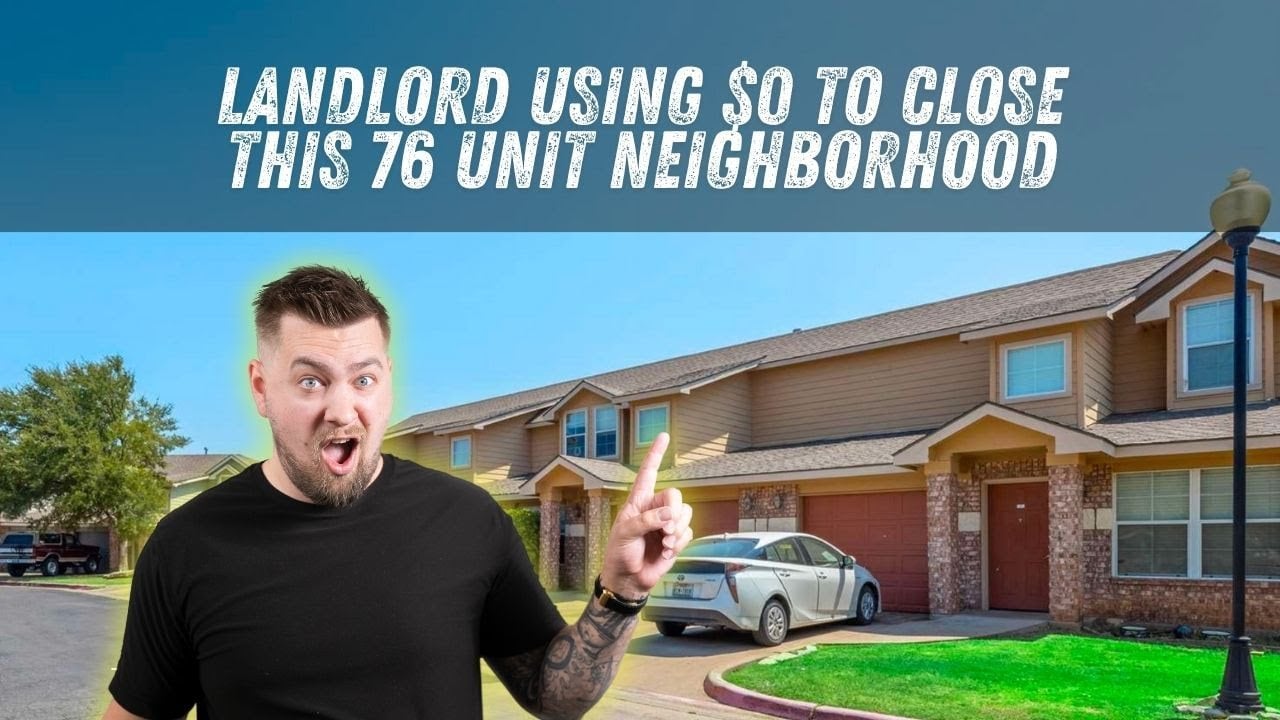
Inside my 76-unit LIHTC property in Stephenville, Texas: standardized units, replaceable parts, Section 8 standards, and how low rent creates near-zero vacancy.
I'm at the 76-unit in Stephenville, Texas: one of four affordable housing projects we're working on here. This one is LIHTC, and we work with Section 8. Between four low-income properties in this town I've done over 186 units.
Related reading: How the 76-Unit Deal Put Me at 170 Units in Stephenville, Texas
The obvious question is how you make money while keeping things genuinely affordable, without turning into a slumlord. That's what this comes down to: a model built on standardized units, replaceable parts, scale in a single market, and a refusal to buy cheap. Do it right and you end up 95 to 100% occupied at 90 to 95% of market rent, with tenants who stay forever.
Before any of that, let me show you my favorite upgrade on this property.
The Flag Rule (and Why It Exists)
The flags out front were tattered. Disrespectful and horrible. We just got new ones up, so America and Texas are flying high again.
Fun fact: those are the only two flags we allow at our properties here in Texas. No political flags, no college flags, no flags of any affiliation of any kind, because whatever goes up, you upset half your tenants. We had so many tenant fights over somebody hanging a flag that set off everyone else that we finally just said, "Hey guys, do not do these."
It's a small rule, but if you're going to buy a bunch of apartments, it'll save you a lot of grief.
Rule One: Stop Buying Cheap
Here is the most important thing about low-income housing: we do not want to run a slum. Walk this campus and you'll notice the buildings are actually nice and the landscaping looks good. That's not charity, it's the model.
The model starts with a rule people hate hearing. Do not, do not, do not, do not buy cheap houses. Cheap is bad, like cheap anything else. Cheap loses money.
The trap is obvious once you've watched it happen. You buy a beat-up little property, you're cash flowing a few hundred bucks a month, and you tell yourself you'll put a Section 8 tenant in there and make a bunch of money. Then the dishwasher goes out and half your year's cash flow is gone.
So people buy a whole bunch of these and get a whole bunch of problems. And the bigger that pile gets, the harder it is to manage.
The first thing with low income is to eliminate the single family. Houses are for families. Apartment complexes are a business for investors.
What LIHTC Actually Is
Two of my properties here are LIHTC, which is Section 42 of the tax code.
The mechanics: we have to rent to people who make little enough relative to the area median income, and we have temporary restrictions on what we can charge for rent at the property. You're not in the program forever. It's the government's way of incentivizing developers to build housing for lower-income individuals in exchange for accepting rent restrictions, and those developers get massive tax benefits for keeping properties in the program: usually 15 to 30 years.
What that means as a buyer is actually simple. Because you have fixed variables and hard restrictions, the numbers are easy to underwrite. You have to buy for day one cash flow, period, because you are limited in your ability to increase income for an extended period of time. There's no "we'll push rents" story to lean on.
The upside comes later. Hold these long enough and eventually LIHTC expires, or you take one of a few different exits from the program, and all of a sudden the value of the building doubles. That will eventually happen here.
But that's not the primary goal. The primary goal is to buy properties with enough income to keep the property nice, make a profit, and most importantly keep rent affordable.
Standardize Everything
Number one operational rule: standardize the units.
Same flooring, same paint color, same stains, same countertops. Everything is the same. I have a storage shed up the hill holding all of our materials, and we always buy more than we need. The more projects we do, the more we save on the next ones. That compounding is a massive help.
Go to any of my units in this town (all 186 of them) and you'll find the same paint colors, the same color scheme, the same flooring, the same appliances. We have set vendors.
Be clear about why you're doing this. You're working for efficiency so you get cost savings, not so you can simply pocket more money: though that's a side benefit. You're doing it so you can provide excellent housing for excellent people.
Buy Big Enough, or Buy Enough
The second structural rule: buy properties that are big enough to support on-site management, or buy enough properties in one place that your smaller ones can benefit from the on-site capability of your larger ones.
That's exactly what I did in Stephenville. Four properties, 186 units, one town. The bigger campuses carry the staffing capability that the smaller ones can't justify on their own.
Stack your units in one market and all your materials live in one spot, your vendors serve everything, and your savings can actually get passed down to your tenants.
Replaceable Parts, and Reinvesting Every Year
You want enough cash flow to consistently reinvest back into the property every single year. There is no set-it-and-forget-it real estate, and there's definitely no set-it-and-forget-it affordable housing.
The design principle is replaceable parts, and the question is always: what's the nicest stuff we can get for the least amount of money?
Light fixtures are the perfect example. When we go in and update fixtures, they're modern and they look far nicer than the old stuff. They change how the whole unit reads, and they're about $100 a fixture, and we get contractor discounts because we buy them in bulk. So we keep a pile of them on hand, and every time we renovate a unit, boom, modernized.
Anywhere we find carpet, we bring it to glue-down LVP. It looks absolutely gorgeous, it's simple, it's easy, and it's replaceable.
That's the whole formula: keep the cost down, make sure the units look nice, and use parts you can swap.
How Low Rent Makes You More Money
Here's the part that sounds backwards until you've run it.
When you get really efficient and you keep your costs down, you're allowed to offer less expensive rent. When you have less expensive rent, you have very little vacancy, because you're offering a nicer space than competitors would have to charge more for.
I can make a profit with nicer units at a lower price. That means more money, not less.
What you end up with is apartments sitting at 90 to 95% of market rent, tenants who stay forever because you're still the most affordable option in the space, and 95 to 100% occupancy. At that point you've effectively maxed your revenue and reduced your chance of move-out at the same time.
Renovate Every Building to Section 8 Standards
This is the strategy I think every multifamily owner needs to consider: how are you using Section 8 in your portfolio?
Make every single building meet Section 8 standards. It's a higher standard than you think. If you renovate to it, even your market rate tenants are getting a better deal, and your safety compliance and your liability exposure both improve.
On top of that, you open the door to people who need housing assistance. On this campus, about 20 of the 76 residents are on Section 8 and Section 42. They have reduced rent, but the majority of that rent (if not all of it) is paid out of my tax dollars and your tax dollars. It comes back to me in exchange for providing housing.
Related reading: The Section 8 Stack: How a $91 Rent Bump Made $1.7 Million
I think everyone should be on these programs. You're allowed to screen exactly the same way you otherwise would, and we have fantastic tenants. Section 8 done right is the same thing everything else here is: providing excellent housing to excellent people. The fact that someone needs a leg up is a better reason to help them, not a worse one.
Leave It Nicer Than You Bought It, and Walk It Like a Buyer
Every one of these deals should get better and better every year. Always leave extra budget for projects.
Right now the example is the fencing around the trash cans, which was falling down. I don't want to look at a row of trash cans when I'm a tenant walking the property. The metal posts are up, the wood is coming in, and we'll have a new fence that looks far better and is built to last. Is it a huge expenditure? No. But it's the little things.
Here's the hack that saves me the most money, and I'm doing it today. I drove down and I'm walking every single property, and as I do it, I'm pretending I'm buying the property, not that I already own it. You go around asking, "If I were buying this, what would I change about current ownership?" Every time, I find something and think, gosh, what were these owners thinking. Then I remember the owner is me.
Today's find is trash around the campus. Our landscaping is excellent: it's November so the grass is brown, but it's normally green and it's well managed. And then there's garbage lying around the sides of everything, boxes and cans out, and it makes the whole place look trashy.
So the first question is: who owns that task in this company? And I realized we hadn't delegated it to anyone. We have a landscaper. We have a property manager. Nobody knew who was supposed to do what. Easy fix.
Do this on every property, but especially on low income. This is the stuff tenants appreciate the most: the little things and the attention to detail.
Key Takeaways
- Don't buy cheap. One dishwasher failure can erase half a year of cash flow on a small, beat-up property.
- Houses are for families; apartment complexes are the business. Eliminate single family from your low-income strategy.
- LIHTC (Section 42) caps your rent growth for 15 to 30 years, so you must buy for day one cash flow: the value jump comes at program exit.
- Standardize everything: same flooring, paint, countertops, appliances, vendors. Stockpile materials and buy more than you need.
- Buy big enough for on-site management, or stack enough units in one market that the big properties carry the small ones.
- Use replaceable parts: $100 modern light fixtures bought in bulk, glue-down LVP replacing carpet.
- Renovate every building to Section 8 standards. It raises quality for market tenants too, and lets you serve residents with assistance.
- Lower rent plus lower cost produces 95 to 100% occupancy at 90 to 95% of market rent.
- Walk your own properties as if you're buying them. Today it caught an unassigned trash pickup task.
Providing affordable housing is always in need, in any city in the U.S. If you can provide the best product at the lowest price, that's the way to do it, and you only get there with replaceable parts and scale.
Watch the full video for the walk-through of the 76-unit and the upgrades in progress. Our free multifamily course is at multifamilystrategy.com/get-free-training, mentorship details are linked in the description, and the free Skool community (where a lot of people are buying these deals with creative finance) comes with a deal calculator.
Related reading: Why My 44-Unit 55+ Community Is My Best Texas Deal
Read the episode transcript
0:00 Hello and welcome to the 76 unit. This
0:01 is [music] one of four affordable
0:03 housing projects that we're working on.
0:04 This one's LITC. We work with section 8.
0:06 [music] I have done over 186 units in
0:09 this town. And how are we making money
0:11 while keeping [music] things affordable?
0:12 I'm going to share with you exactly on
0:14 this video, the strategy that you can
0:16 use, and what you need to [music] do to
0:17 keep cost down, profits up, and have
0:20 happy tenants without being a slum load.
0:22 First, I need to show you my favorite
0:23 upgrade to this property. We're at the
0:24 76 unit. These flags were tattered. Just
0:28 disrespectful and horrible. We just got
0:29 the new flags up. America and Texas are
0:32 flying high. As a fun fact,
0:36 we only allow those two flags at our
0:37 properties here in Texas. The reason
0:39 being any political flags or any college
0:41 flags, any flags of any affiliation of
0:43 any kind, you piss off half the tenants.
0:46 So, we just said, "Hey guys, do not do
0:47 these." We had so many tenant fights
0:49 because people would put up some flag
0:51 that pissed off the other half of the
0:52 tenants. This is a little hack that'll
0:54 help you out if you buy a bunch of
0:55 apartments like I'm going to talk about
0:57 today. Let's talk low-income housing.
0:58 So, this project here, this 76 units.
1:00 I'll be walking around this as I talk.
1:02 This is a LITC property. I have two of
1:05 these in Stevenville, Texas, but I have
1:07 four low-income properties here in Texas
1:09 making up 186 units. Now, on this
1:11 channel, I often cover how we buy these
1:13 with Creative Finance. We have a whole
1:15 school community sky
1:18 family strategy with a community of
1:19 people who do the exact same thing. So,
1:20 you want to know how to do it? Uh, go
1:22 over there. The information is free. for
1:24 lowincome housing. This is the most
1:27 important thing. We do not want to have
1:29 a slum. So, when you're going through,
1:30 you're going to notice a lot of these
1:32 buildings are really nice. The
1:33 landscaping is looking really good.
1:36 Here's the model for low-income housing
1:37 done right. First of all, do not do not
1:40 do not do not buy cheap houses like
1:44 cheap anything else. Cheap is bad. Cheap
1:47 loses money. It is so hard because what
1:49 happens is you might be cash flowing a
1:51 few hundred bucks a month. I've seen
1:52 these small properties, these beat up
1:54 properties. You're like, "Hey, we're
1:55 going to get section 8 in here. We're
1:57 going to make a bunch of money." And
1:58 then the dishwasher goes out and
2:00 suddenly half your year's cash flow is
2:03 gone. What ends up happening is people
2:05 buy a whole bunch of these, they get a
2:06 whole bunch of problems. The bigger you
2:08 get, the harder it is to manage. So, the
2:10 first thing with low income is eliminate
2:12 the single family. Houses are for
2:14 families.
2:16 Apartment complexes, that's a business
2:19 for investors. So we're going to talk
2:20 about how we run these. Now what is
2:22 LITC? As two of my properties are this
2:24 section 42 of the tax code. Essentially
2:27 we have to rent to people who make
2:28 little enough compared to the area
2:31 median income and we have some temporary
2:34 restrictions on what we can charge for
2:36 rent at this property. Now you're not in
2:38 this program forever, but this is a way
2:40 that the government incentivizes
2:42 developers to build properties for
2:45 lower-income individuals in exchange for
2:46 the restrictions on rent. Those
2:48 developers get massive tax benefits for
2:51 keeping these in the programs which are
2:52 usually 15 to 30 years. When you're
2:55 buying these because you have fixed
2:57 variables and restrictions, the numbers
2:59 are super easy. You have to buy for day
3:02 one cash flow period because you are
3:04 limited on your ability to increase your
3:06 income for an extended period of time.
3:08 Now, you hold these long enough,
3:09 eventually LITC will expire or there's a
3:12 few different exits that you can have
3:13 from the program where all of a sudden
3:15 the value of the building doubles, which
3:17 will eventually happen here. But our
3:19 primary goal is to buy properties that
3:21 have enough income to keep the
3:23 properties nice, to make a profit, but
3:26 most importantly to keep rent
3:27 affordable. So, how do you do it for a
3:29 property like this? Number one thing,
3:32 standardize the units. It's the same
3:34 flooring, the same paint color, the same
3:35 stains, the same countertops. Everything
3:38 is the same. I have a storage shed up
3:41 the hill that has all of our materials
3:43 in it. Always buy more than you need.
3:45 The more projects we do, the more we
3:46 save on future projects. Massive,
3:49 massive help. Next, buy properties that
3:52 are big enough to have on-site
3:53 management or buy enough properties like
3:56 I did in Stevenville, Texas, where the
3:58 smaller properties can benefit from the
4:01 on-site abilities of your larger
4:03 properties. But the goal here is to buy
4:05 big enough and to get consistent. If you
4:08 go to any of my units, all 186 of them
4:11 in this town, same paint colors, same
4:13 color scheme, same flooring. I think I
4:16 said colors twice, same appliances. You
4:20 get the gist. We have set vendors. It's
4:22 you working for efficiencies so you have
4:24 cost savings, not so you just make more
4:27 money, though that is a side benefit.
4:29 You're doing it so you can provide
4:30 excellent housing for excellent people.
4:32 You want to have enough cash flow to
4:34 consistently every year reinvest back
4:37 into the property. There is no set it
4:39 and forget it real estate and affordable
4:40 housing. Make sure that you use
4:42 replaceable parts. You have a model
4:43 where it's, hey, what is the nicest
4:44 stuff we can get for the least amount of
4:46 money? Perfect example, our light
4:48 fixtures. When we go in and update the
4:49 light fixtures, they're modern. They're
4:52 way nicer looking than all the old
4:54 stuff. Makes the whole unit look
4:55 different and they're like $100 a
4:58 fixture. And we get contractor discounts
5:00 because we buy them in bulk. So now we
5:02 have a whole ton of these every time we
5:04 ren a unit. Boom. Modernized. Anywhere
5:06 that we find carpet, we bring it to LVP.
5:09 Glue down LVP. Looks absolutely
5:11 gorgeous. It's simple. It's easy.
5:14 Replaceable parts. Keep the cost down.
5:16 make sure the units look nice. Now
5:18 though, how do you make a ton of money
5:20 doing this? Well, when you get really
5:21 efficient at this and you're keeping
5:23 your cost down, you're allowed to offer
5:26 less expensive rent. When you have less
5:27 expensive rent, you have very little
5:29 vacancy because you have a nicer space
5:31 than other people would have to charge
5:32 more for. I can make a profit with nicer
5:36 units, lower price. Guess what that
5:38 means? More money for you. The other
5:40 strategy that I think all multif family
5:42 owners need to consider, how are you
5:44 using section 8 in your portfolio? make
5:46 every single building up to the section
5:48 8 standards. It's a higher standard than
5:50 you think, which means if you renovate
5:52 to this, even the market rate tenants
5:54 are getting a better deal. Your safety
5:56 compliance, your liability, all this
5:58 stuff is better. In addition, people who
6:01 need help housing, who have government
6:03 assistance I get for this campus,
6:05 there's like 20 people out of 76 that
6:08 are on section 8 and on section 42. So
6:11 they have reduced rent, but still a
6:13 majority of that rent, if not all of
6:15 that rent, is being paid out of my tax
6:18 dollars and your tax dollars. It comes
6:20 back to me in exchange for providing
6:22 housing. You can rent to people who need
6:25 help and you give a nicer space because
6:27 the government is helping them out. I
6:29 think everyone should be on these
6:30 programs. You're allowed to screen the
6:32 exact same way. We have fantastic
6:35 tenants, maintenance problems,
6:37 non-payment. Section 8, when done right,
6:40 is providing, just like always,
6:42 excellent housing to excellent people.
6:44 The fact that they need a leg up is a
6:46 better reason to help them out. The last
6:48 thing you do is you make sure the thing
6:50 is just nicer than you bought it. All
6:51 the time when you're buying for any of
6:53 these deals, they get better and better
6:55 and better every year. Always leave
6:56 extra for projects. Example, these
6:59 fences were falling down around the
7:01 trash cans. I don't want to see a bunch
7:02 of trash cans when I'm a tenant walking
7:04 around the property. We just got these
7:05 metal posts up. Wood's coming in. and
7:08 we're going to have a brand new fence
7:09 around this is going to look way better,
7:11 but we put something sustainable up
7:13 that's going to make the campus better.
7:14 Is it a huge expenditure? No. But it's
7:16 the little things. Here's a hack that I
7:19 learned. This actually saves me a ton of
7:20 money. I'm doing this today. I drove
7:22 down to the properties. I'm walking
7:24 every single property. And as I do it,
7:26 I'm pretending I'm buying the property,
7:29 not that I already own it. What you
7:30 find, you walk around, you go like,
7:32 "Hey, if I was buying this property,
7:34 what things would I change from the
7:36 current ownership?" And every time I do
7:38 this, I find things where I'm like,
7:40 gosh, these owners, what are they
7:41 thinking? We forgot to do something. And
7:43 then I'm like, all right, the owner's
7:44 me. My big thing today is just the trash
7:46 around campus. There should have been a
7:48 plan on how this gets picked up. So, we
7:50 have excellent landscaping. Uh, granted,
7:53 the grass is, you know, it's November.
7:56 The grass is kind of dead, so if you're
7:57 seeing brown, it's usually green. But
7:59 you're looking down here. Look at this.
8:02 Well landscaped, well managed. you have
8:05 garbage lying around on all the sides of
8:07 everything. You have boxes out, cans, it
8:10 makes the whole thing look trashy. So,
8:11 the first thing I would do is like,
8:12 okay, who owns that task in this
8:15 person's company? And I realized we
8:17 didn't delegate anyone to that. We just
8:18 have a landscaper. We have a property
8:20 manager. No one knows who's supposed to
8:22 do what. Easy fixes. Do this on every
8:25 property, but especially the low income.
8:27 This is the stuff that your tenants
8:28 appreciate the most. It's the little
8:29 things and the attention to detail. If
8:31 you do this, here's what you end up
8:33 with. apartments that are at 95 90 to
8:35 95% of market rent. You have tenants who
8:38 stay forever because you're still the
8:40 most affordable in the space. And you
8:41 stay between 95 and 100% occupied, which
8:44 means you have effectively maxed your
8:46 revenue and reduced your chance of move
8:48 out. You do this in any city in the US
8:51 that needs housing. Providing affordable
8:53 housing is always in need. If you can
8:56 provide the best product at the lowest
8:58 [music] price, that's the way to do it.
9:00 And you only do it with replaceable
9:01 parts and you do it with scale. Stop
9:03 buying single family, [music]
9:04 start buying multif family and stack
9:06 your units in one market so all of your
9:09 materials are in one spot. Your savings
9:11 can be passed to your tenants and that
9:13 is being a good landlord.
Put these ideas to work.
Get support from Christian and the coaching team with your next multifamily deal. See how the mentorship works or start your application.
Apply Now